|
![]() ![]() ![]() |
Resultant Vector, Sum of VectorsHow to calculate the resultant vectorThis Page : parallelogram method | Head To Tail Method |Head to Tail Practice Resultant Vector | pictures of Vectors
The resultant vector is the vector that 'results' from adding two or more vectors together. There are a two different ways to calculate the resultant vector.
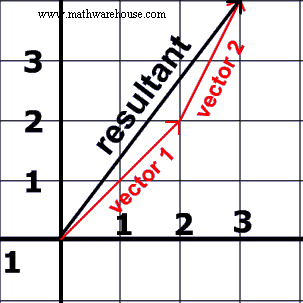
In the picture on the left, the black vector is the resultant of the two red vectors. To try to understand what a resultant is consider the following story.
If you drove from your house, centered at the origin. To your friends house, at the point (3,4), imagine that you had to take two different roads these are the two red vectors.
However, the resultant vector vector would be the straight line path from your home to your friend's house, and the black vector represents that path.
Head to Tail MethodThe head to tail method is way to find the resultant vector. The steps are quite straight forward. The head to tail method considers the head of a vector to be the end with the arrow, or the 'pointy end'. The tail of the vector is where the vector begins.
Steps for Head to Tail MethodCalculate the magnitude resultant vectorFind the sum of each pair of vectors (the magnitude of the resultant vector).
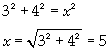
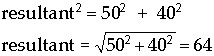
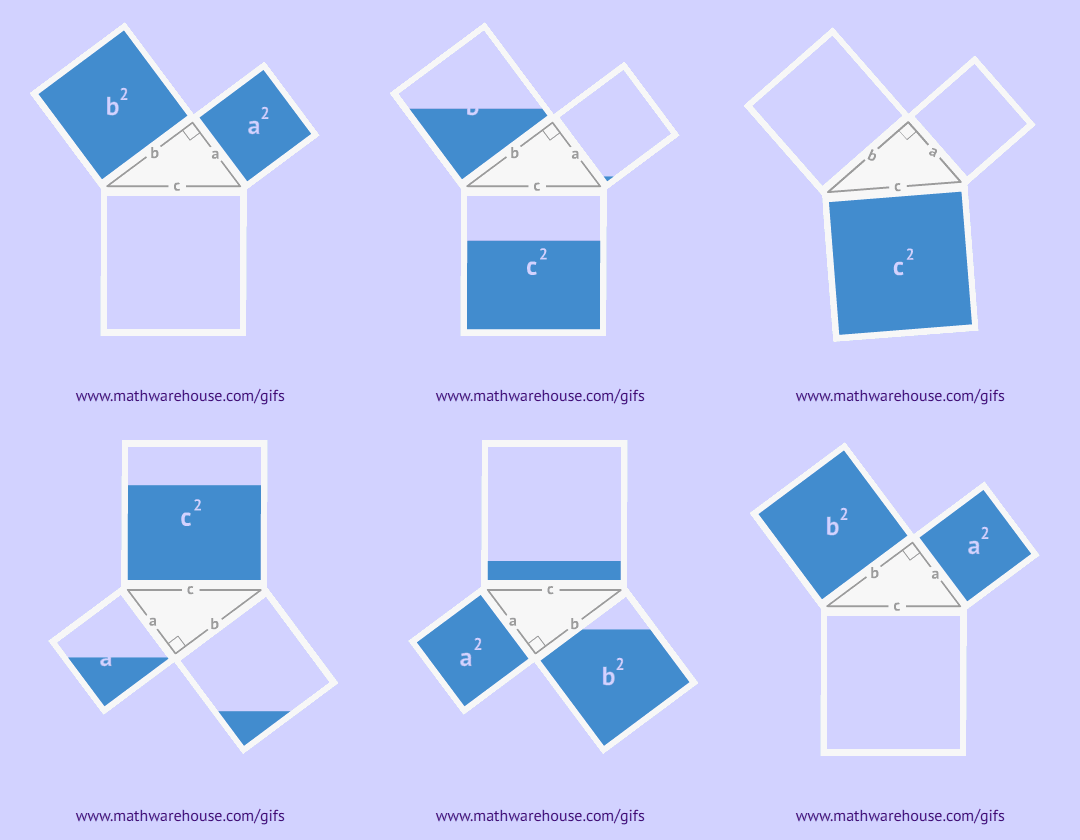
resultant vector To find the resultant vector's magnitude, use the pythagorean theorem.
Practice Problems
Problem 1)
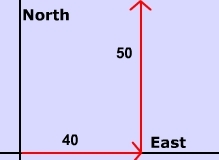
1. You left your house to visit a friend. You got in your car drove 40 miles east, then got on a highway and went 50 miles north.
Draw a vector from the beginning of your journey, your home, and the end, your friend’s house. Draw Resultant 2. How long is the vector that you drew?
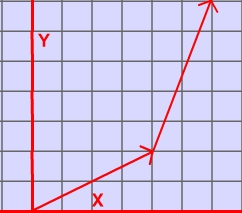
What is the sum of the two vectors? Use the head to tail method to calculate the resultant vector in the picture on the right Draw Resultant Vector Parallelogram Method to Calculate Resultant
Before tackling the parallelogram method for solving resultant vectors, you should be comfortable with the following topics
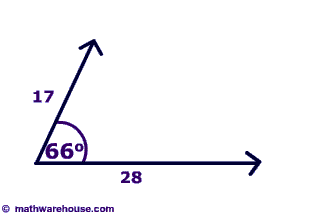
To best understand how the parallelogram method works, lets examine the two vectors below. The vectors have magnitudes of 17 and 28 and the angle between them is 66°. Our goal is to use the parallelogram method to determine the magnitude of the resultant.
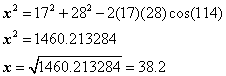
Use the law of cosines to calculate the resultant.
|