| ∠ A | |
|---|---|
| ∠ B | |
| ∠ C | |
| ∠ D |
Drag Points To Start Demonstration

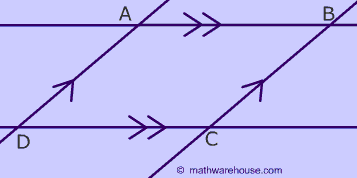
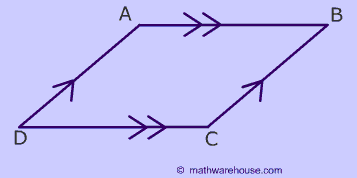
A parallelogram is a quadrilateral made from two pairs of intersecting parallel lines. There are several rules involving:
| ∠ A | |
|---|---|
| ∠ B | |
| ∠ C | |
| ∠ D |
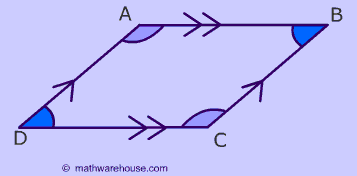
To create a parallelogram just think of 2 different pairs of parallel lines intersecting. ABCD is a parallelogram.
$$ \angle D \cong \angle B \\ \angle A \cong \angle C $$
Triangles can be used to prove this rule about the opposite angle.
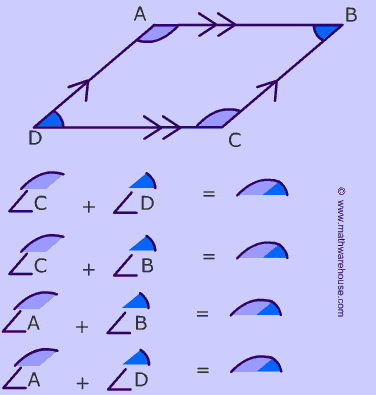
The following pairs of angles are supplementary
$$ \angle C $$ and $$ \angle D $$
$$ \angle C $$ and $$ \angle B $$
$$ \angle A $$ and $$ \angle B $$
$$ \angle A $$ and $$ \angle D $$
To explore these rules governing the angles of a parallelogram use Math Warehouse's interactive parallelogram.
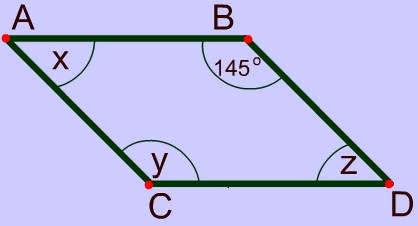
There are many different ways to solve this question. You know that the opposite angles are congruent and the adjacent angles are supplementary.
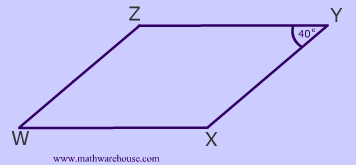
$$ \angle \red W = 40^{\circ} $$ since it is opposite $$ \angle Y $$ and opposite angles are congruent.
Since consecutive angles are supplementary
$$
m \angle Y + m \angle Z = 180 ^{\circ}
\\
40^{\circ} + m \angle Z = 180 ^{\circ}
\\
m \angle Z = 180 ^{\circ} - 40^{\circ}
\\
m \angle \red Z = 140 ^{\circ}
$$
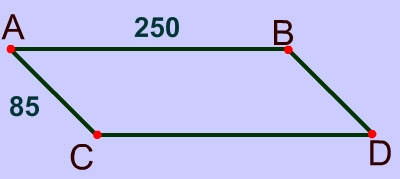
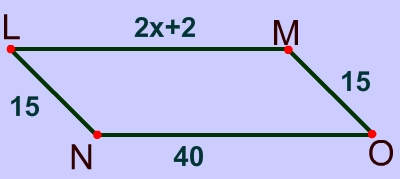
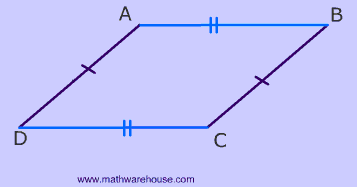
The opposite sides of a parallelogram are congruent.
Triangles can be used to prove this rule about the opposite sides.
To explore these rules governing the sides of a parallelogram use Math Warehouse's interactive parallelogram.
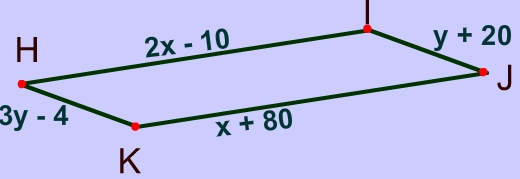
What is the value of x and y in the parallelogram below?
Since opposite sides are congruent you can set up the following equations and solve for $$x $$: $ \text{ Equation 1} \\ 2x − 10 = x + 80 \\ x - 10 = 80 \\ x = 90 $
Since opposite sides are congruent you can set up the following equations and solve for $$y $$: $ \text{ Equation 2} \\ 3y − 4 = y + 20 \\ 2y − 4 = 24 \\ 2y = 24 \\ y = 12 $
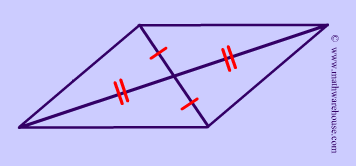
The diagonals of a parallelogram bisect each other.
AO = OD
CO = OB
To explore these rules governing the diagonals of a parallelogram use Math Warehouse's interactive parallelogram.
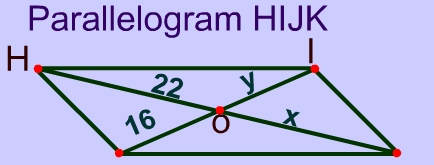
What is x and Y?
Since the diagonals bisect each other, y = 16 and x = 22
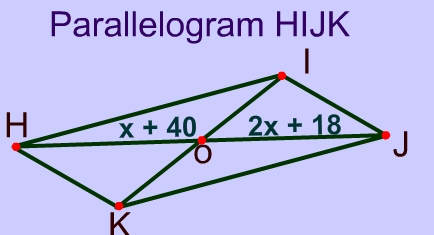
What is x?
$$ x + 40 = 2x + 18 \\ 40 = x +18 \\ 40 = x + 18 \\ 22 = x $$
A classic activity: have the students construct a quadrilateral and its midpoints, then create an inscribed quadrilateral. Then ask the students to measure the angles, sides etc.. of inscribed shape and use the measurements to classify the shape (parallelogram). Designed with Geometer's Sketchpad in mind .