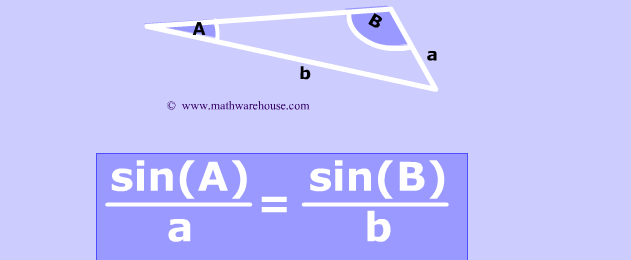
The law of sines formula allows us to set up a proportion of opposite side/angles
(ok, well actually you're taking the sine of an angle and its opposite side).
There are two different situations when you use this formula. But really, there is just one case .
Just look at it:
You can always immediately look at a triangle and tell whether or not you can use the Law of Sines -- you need
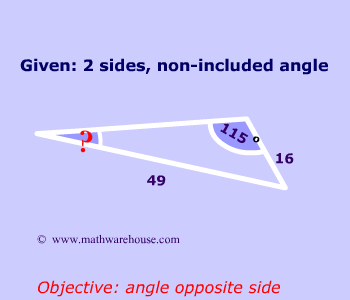
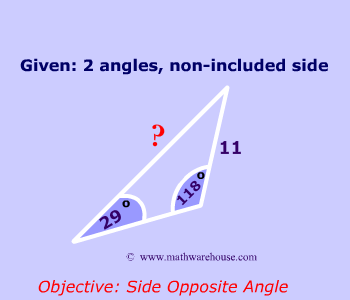
3 measurements: either 2 sides and the non-included angle or 2 angles and the non-included side.
It's all about opposites:
To use the law of sines, you need to know one opposite angle/side pair measurements.
Cases when you can not use the Law of Sines
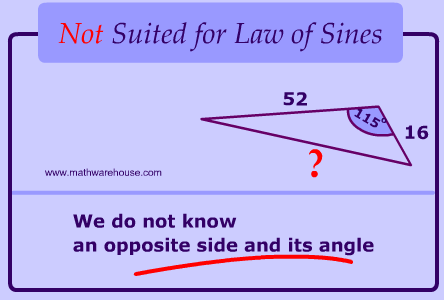
The picture below illustrates a case not suited for the law of sines. Since we do not know
an opposite side and angle, we cannot employ the formula.
Or, just look at it: Remember when you have 2 sides, the angle
must benon-included.
By the way, we could use the law of cosines
to find the length of the side opposite the 115° angle.
Do you know when to use the formula?
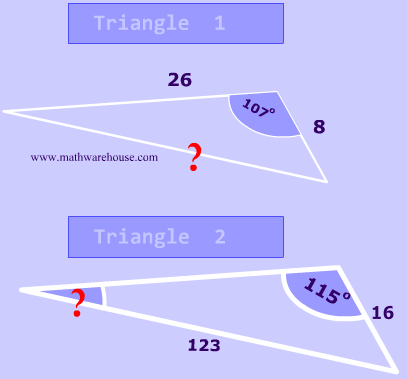
In which triangle(s) below, can we use the formula? Both triangles below have 3 known measurements.
Triangle 1 has only one opposite pair that we are dealing with, but
that does not help us because we need to know both the angle and itsopposite side.
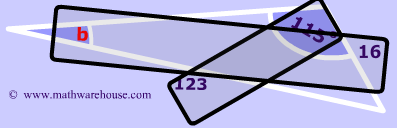
Or, just look at it: Remember when you have 2
sides, the angle must be non-included.
$$
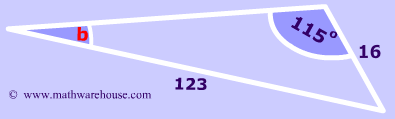
\frac{ sin( \red b)}{ 16} = \frac{ sin(115)} {123}
\\
sin( \red b ) = \frac{ 16 \cdot sin(115)} {123}
\\
sin( \red b ) = 0.11789369587468619
\\
\red b = sin^{-1} ( 0.11789369587468619 )
\\
\red b = 6.770557323410266
\\
\red b \approx 6.8
$$
Problem 2
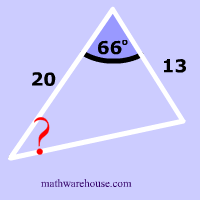
Can we use the law of sines to solve for the labelled angle?
No, because we need to know the measure of 1 opposite side and angle.
We can not use side with length 20 because we don't know its
opposite angle.
And we can't use 66 ° angle because we don't know its
opposite side.
And, of course, we do not know the measure of the angle opposite of the side of length 13 because...
well, because that's the very thing we are solving for!
Just look at it: Remember when you have 2 sides, the angle must be non-included.
Problem 3
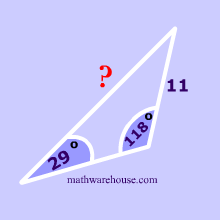
Can we use the law of sines to solve for the labelled angle?
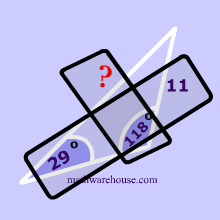
Yes, because we need to know the measures of one opposite side and angle which we have with the 29 ° angle
and the side of length 11. And we know the angle (118 °) opposite the side length that we are solving for.
Or just look at it: Remember when you have 2 angles, the side must be non-included.
Problem 4
(Follow up from question 3). Now, use the formula for law of sines to determine the measure of the labelled side to the
nearest tenth.
Step 1
Set up proportion with 2 pairs of opposite sides/sines of angles
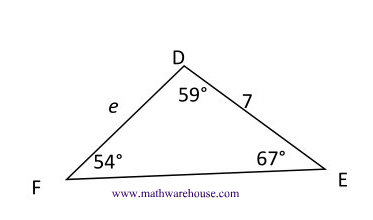
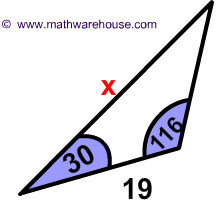
Is it possible to use the law of sines to calculate x pictured in
the triangle below?
Step 1
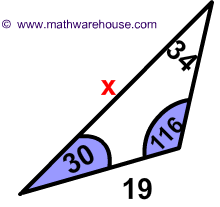
Yes, first you must remember that the sum of the interior angles of a triangle
is 180 in order to calculate the measure of the angle opposite of the side of length 19.
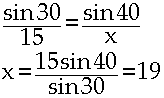
Now that we have the measure of that angle, use
the law of sines
to find the value of x