Interactive Parabola Grapher
Explore graph ,equation and the locus of a Parabola
Save graphs to your desktop!


A+    A−    B  
Home
Graphing Calc
Algebra
Math Games
  • Decimals in Space
  • Fraction Balls
  • Integers in Space
  • Math Man
  • Number Balls
  • Geometry
    Interactive
    Trigonometry
    Scientific Calc
    Home
    Graphing Calc
    Algebra
    Math Games
  • Decimals in Space
  • Fraction Balls
  • Integers in Space
  • Math Man
  • Number Balls
  • Geometry
    Interactive
    Trigonometry
    Scientific Calc

    Isosceles Triangle Proofs

    Theorems and practice

    Proofs involving isosceles triangles often require special consideration because an isosceles triangle has several distinct properties that do not apply to normal triangles.(More about triangle types) Therefore, when you are trying to prove that two triangles are congruent, and one or both triangles, are isosceles you have a few theorems that you can use to make your life easier.

     Isosceles Triangle  


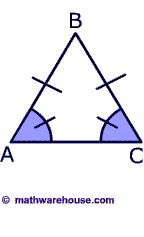
    An isosceles triangle has two congruent sides and two congruent angles. The congruent angles are called the base angles and the other angle is known as the vertex angle. BAC and BCA are the base angles of the triangle picture on the left. The vertex angle is ABC

    Isosceles Triangle Theorems


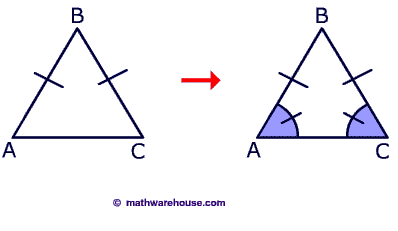
    The Base Angles Theorem
    If two sides of a triangle are congruent, then the angles opposite those sides are congruent.
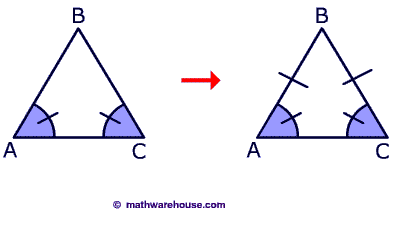
    Converse of the Base Angles Theorem
    The converse of the base angles theorem, states that if two angles of a triangle are congruent, then sides opposite those angles are congruent.
    See this isosceles Triangle proof all by itself(opens up new window, making it easier to see entirety of proof below)
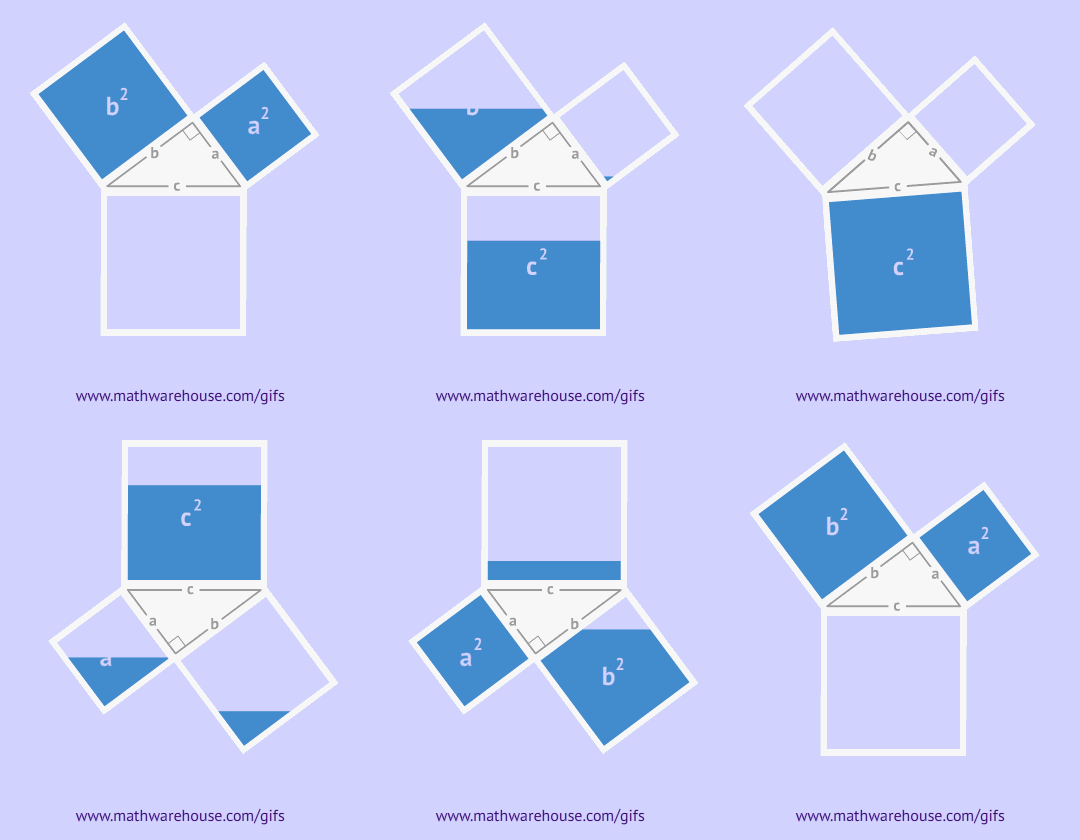
    Below is a formula proof that does not use isosceles triangles. However, can you figure out how to rewrite the proof using isosceles triangles and their theorems. (Note: answer to question is forthcoming)