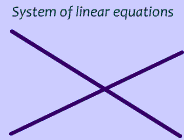
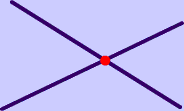
A system of linear equations means two or more linear equations. (In plain speak: 'two or more lines') If these two linear equations intersect, that point of intersection is called the solution to the system of linear equations
When you are trying to calculate the solution of a system of linear equations, you can will arrive at
one of three distinct cases:
These cases only apply to systems of two lines. If you are working with systems with three or more linear equations (lines), you cannot use the blanket generalizations made below.
The system has exactly 1 solution.
Systems have 1 and only 1 solution when the two lines have different slope. Think about it, if the two lines have different slopes then eventually at some point they must meet. After all the lines are not parallel.
system has no solutions
Systems have no solution when the lines are parallel (ie
have the same slope) and the lines have different y-intercepts.
As an example look at the following two lines
Line 1: y = 5x +13
Line 2: y = 5x + 12
The system has infinite solutions
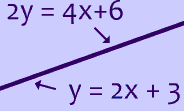
Systems have infinite solutions when the lines are parallel and the lines have the same y-intercept. If two lines have the same slope (ie are parallel) and the same y-intercept, they are actually the same exact line. In other words, systems have infinite solutions when the two lines are the same line!
As an example consider the following two lines
Line 1: y = x +3
Line 2: 2y = 2x +6
These two lines are exactly the same line. If you multiply line 1 by two you get line 2.
The solution of the system of equations on the left is (2,2) which marks the point where the two lines intersect.
To find the solution to systems of linear equations, you can use four methods:
graph : by looking at where lines intersect (meet) on a graph
algebraic equation : by setting the equations of the system equal to each other then solving this equation.
substitution : by solving for one of the variables and substituting its value in to the other equation.
Elimination : Elimination involves algebraic manipulations of two or more equations. The end goal
is to eliminate a variable by creating opposite coefficients (The examples below should clarify this
straightforward approach).
Interactive System of Linear Equations
The Graph Method
On the left, the system of linear equations is the following two lines:
y=x+1
y=2x
What is the solution?
answer
The point (1,2) is where the two lines intersect.
Example Problem
Use the graph method to solve the system of equations on the left.
y = 2x+1
y = 4x - 1
answer
The solution of this system is the point of intersection : (1,3).
Solve the following system of linear equations by graphing.
insert x value into either equation to determine y coordinate of solution
4(1)-1=3
The solution is the ordered pair you've just calculated
(1,3)
Practice Problem
Practice Problem Five
What is the solution to the following system of linear equations:
Line 1: y=3x – 1
Line 2: y= x – 5
step 1
Set the Two Equations Equal to each other then solve for x step 2
1) Substitute the x value, -2, into either equation to determine y coordinate of solution
2) y=(-2) - 5
-7
3) The solution is the point (-2, -7)
Practice Problem Six
Set the two equations equal to calculate the solution to the system below:
Line 1: y= x + 1
Line 2: y= 2x
Answer
The solution of this system is the point of intersection : (1,2).
Below is the graph showing this solution.
Practice Problem Seven
Solve the system of linear equations by setting their equations equal:
Line 1: y= x +5
Line 2: y= 2x +2
Answer
The solution of this system is the point of intersection : (3,8).
Below is the graph showing this solution.
Practice Problem Eight
Solve the system of linear equations by setting their equations equal:
Line 1: y= x – 1
Line 2: y= 2x +2
Answer
The solution of this system is the point of intersection : (-3,-4).
Practice Problem Nine
Solve the system of linear equations by setting their equations equal:
Whenever you arrive at a contradiction such as 3 = 4, your system of linear equations has no solutions.
When you use these methods (substitution, graphing etc...) to find the solution what you're really asking is at what
point (which x coordinate and y coordinate) do the two lines intersect. However, if the only time that they intersect
is when 3 = 4, they are never going to intersect since 3 does not equal four!
Elimination method is an algebraic method for solving systems. To use elimination you perform an operation on 1 equation then add the two equations so that one of the variables cancels.