|
|
|
|
|
|
![]()
![]()
|
Solve Exponential EquationsHow to solve exponential equationsThis page: exponential equations with like bases | exponential equations with unlike bases | exponential equations with negative exponents Related: Exponents | laws of exponents | Rules of Exponents |Negative Exponents | Dividing With Exponents | Fraction Eponents | Exponential Equations
Before you try to solve exponential equations, you must be quite comfortable using the rules and laws of exponents. An exponential equation is simply an equation in which a variable appears in the exponent.
Examples of exponential equationsSteps to solve exponential equationsThere are many different kinds of exponential equations. First, let's focus on exponential equations that have a single term on both sides. These equations can be classified into two different types.
Solving Exponential Equations of the same base (type #1)
Let's solve the following exponential equation: 4x+1 = 49
Solving Exponential Equations of with unlike bases (type #2)
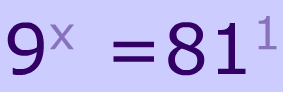
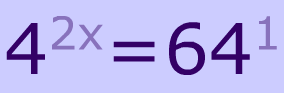
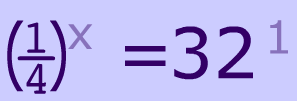
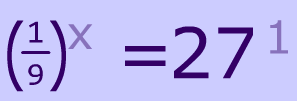
Practice Problems: solving exponential equations
Let's solve : 43 =2x
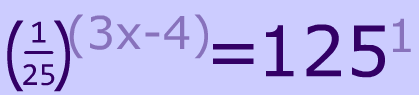
Demonstration Problem 2: Solving Exponential EquationsThis page: exponential equations with like bases | exponential equations with unlike bases | exponential equations with negative exponents Related: Exponents | laws of exponents | Rules of Exponents |Negative Exponents | Dividing With Exponents | Fraction Eponents | Exponential Equations Exponential Equations with Negative ExponentsIt is possible to use the steps outlined on this page to solve exponential equations with negative exponents. Again, it is necessary that both of the bases are powers of a common base. This page: exponential equations with like bases | exponential equations with unlike bases | exponential equations with negative exponents Related: Exponents | laws of exponents | Rules of Exponents |Negative Exponents | Dividing With Exponents | Fraction Eponents | Exponential Equations Top |