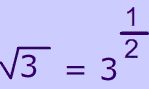
If you've ever calculated the square root of a number then you were actually using a fraction exponent! The square root of a number is the same as raising that number to an exponent of the fraction $$ \frac 1 2 $$
$
\sqrt 3 = 3 ^ {\red { \frac 1 2} }
$
$
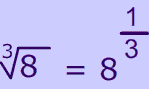
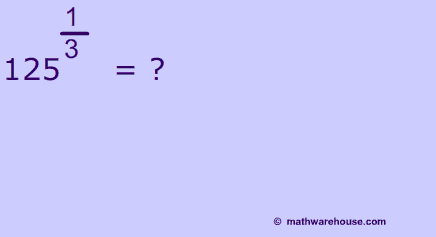
\sqrt[3] 8 = 8 ^ {\red { \frac 1 3} }
$
$
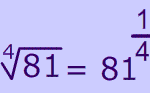
\sqrt[4] 81 = 81 ^ {\red { \frac 1 4} }
$
So how does this work?
We can use one of the laws of exponents to explain how fractional exponents work.
As you probably already know$$ \sqrt{9} \cdot \sqrt{9} = 9 $$ . Well, let's look at how that would work with rational (read: fraction ) exponents . Since we now know $$ \sqrt{9} = 9^{\frac 1 2 } $$ . We can express $$ \sqrt{9} \cdot \sqrt{9} = 9 $$ as :
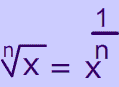
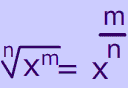
Below is the general formula for a fractional exponent with a numerator of 1.
$
\sqrt[n] x = x ^ {\frac 1 n}
$
$$ \frac 1 n $$ is another way of asking: What number can you multiply by itself n times to get x?
When the numerator is not 1
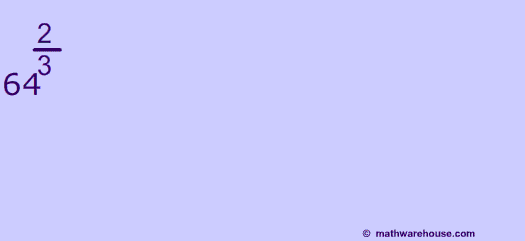
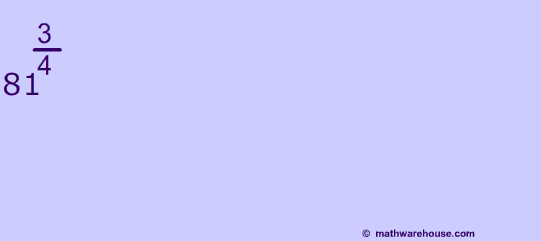
Below is a specific example illustrating the formula for fraction exponents when the numerator is not one. There are two ways to simplify a fraction exponent such $$ \frac 2 3$$ . You can either apply the numerator first or the denominator. See the example below.