
Properties and Operations
Let's look at how (and if) these properties work with addition, multiplication, subtraction and division.
Addition
| Property | Example with Addition | |
|---|---|---|
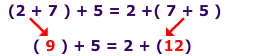
| Distributive Property |

|
|
| Associative |

|
|
| Commutative |

|
|
| Summary: All 3 of these properties apply to addition. | ||
Multiplication
| Property | Example with Multiplication | |
|---|---|---|
| Distributive Property | The distributive property is an application of multiplication (so there is nothing to show here). | |
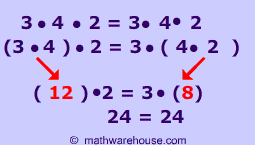
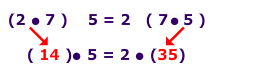
| Associative |
|
|
| Commutative |

|
|
| Summary: All 3 of these properties apply to multiplication. | ||
Subtraction
| Property | Example with Subtraction | |
|---|---|---|
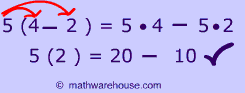
| Distributive Property |
|
|
| Associative |
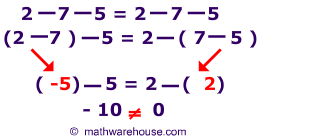
|
|
| Commutative |

|
|
| Summary: The distributive property is the only one that applies to subtraction. | ||
Division
| Property | Example with Subtraction | |
|---|---|---|
| Distributive Property |
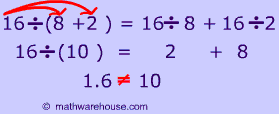
|
|
| Associative |
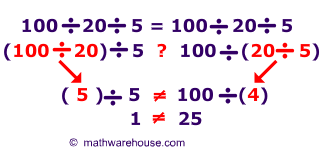
|
|
| Commutative |

|
|
| Summary: None of these properties applies to division. | ||