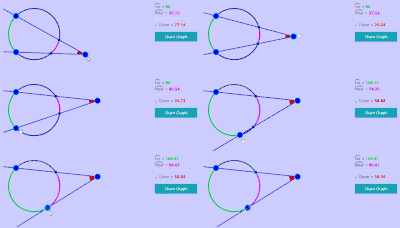
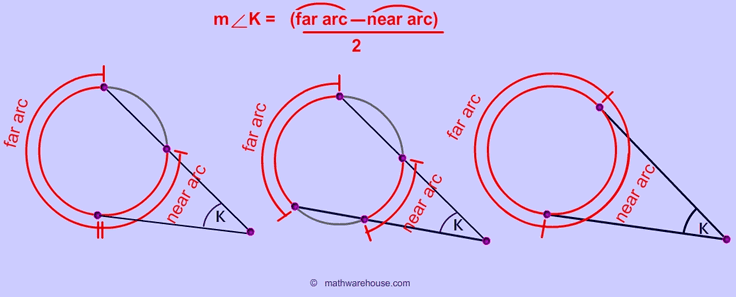
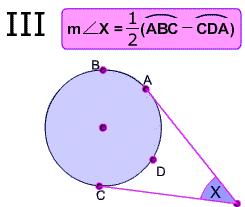
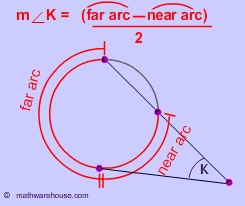
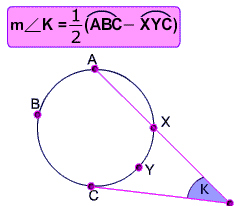
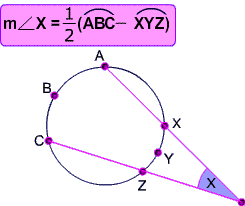
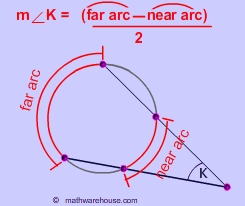
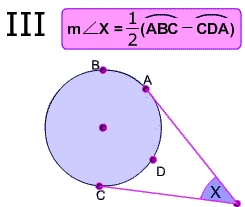
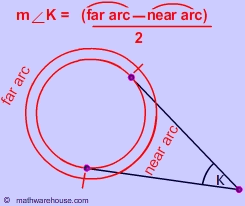
The three theorems for the intercepted arcs to the angle of two tangents, two secants or 1 tangent and 1 secant are summarized
by the pictures below. If you look at each theorem, you really only need to remember ONE formula.
The Formula
The angle formed by the intersection of 2 tangents, 2 secants or 1 tangent and 1 secant outside the circle equals half the
difference of the intercepted arcs! Therefore to find this angle (angle K in
the examples below), all that you have to do is take the far intercepted arc
and near the smaller intercepted arc and then divide that number by two!
That's why we call this the Far Arc Near Arc theorem (sometimes abbreviated Farc - Narc).
Far Arc − Near Arc Formula
All of the formulas on this page can be thought of in terms of a "far arc" and a "near arc".
The angle formed outside of the circle is always equal to the the far arc minus the near arc divided by 2.
The Technical Formulas
Look up above to see the easy way to remember the formulas
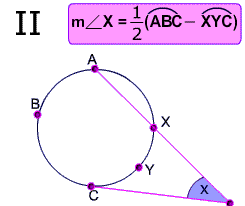
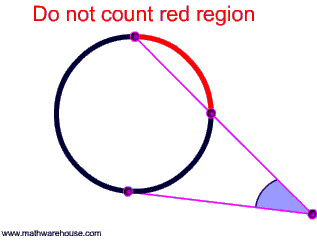
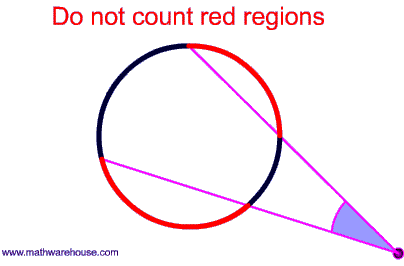
Remember that this theorem only used the intercepted arcs . Therefore, the red arc in the picture below is not used in
this formula.
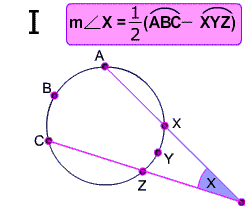
Case II. 2 Secants
The measure of an angle formed by a 2 secants drawn from a point outside
the circle is half the the difference of the intercepted arcs:
In the picture below, the measure of $$ \angle x$$ is $$ \frac 1 2 $$ the difference of the arcs intercepted by the two secants.
Remember that this theorem only makes use of the intercepted arcs. Therefore, the red arcs in the picture below are not
used in this theorem's formula.
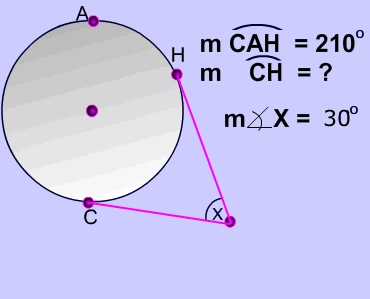
Case III. 2 Tangents
The measure of an angle formed by a two tangents
drawn from a point outside the circle is $$\frac 1 2 $$ the the difference of the intercepted arcs .
In one way, this case seems to differ from the others-- because all circle is included in the intercepted arcs.
Since both of the lines are tangents, they touch the circle in one point and therefore they do not 'cut off' any parts of
the circle.
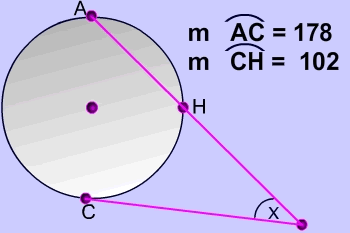
Apply the formula .
$$
m \angle x = \frac{1}{2} \left( \overparen{Farc} - \overparen{Narc} \right)
\\
m \angle x = \frac{1}{2} \left( \overparen{AC} - \overparen{CH} \right)
\\
m \angle x = \frac{1}{2} \left( \overparen{178^{\circ}} - \overparen{102^{\circ}} \right)
\\
m \angle x = 38^{\circ}
$$
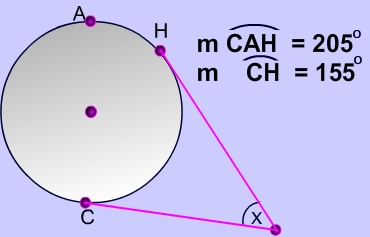
$$
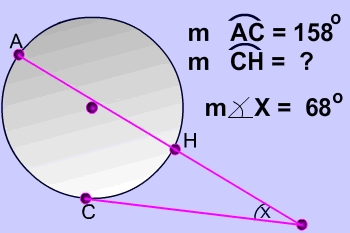
m \angle x = \frac{1}{2} \left( \overparen{Farc} - \overparen{Narc} \right)
\\
m \angle x = \frac{1}{2} \left( \overparen{CAH} - \overparen{CH} \right)
\\
m \angle x = \frac{1}{2} (205-155)
\\
m \angle x = \frac{1}{2} (50)
\\
m \angle x = 25^{\circ}
$$
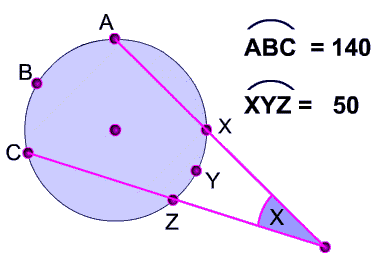
$$
m \angle x = \frac{1}{2} \left( \overparen{Farc} - \overparen{Narc} \right)
\\
m \angle x = \frac{1}{2} \left( \overparen{ABC} - \overparen{XYZ} \right)
\\
m \angle x = \frac{1}{2}(140-50)
\\
m \angle x = \frac{1}{2}(90)
\\
m \angle x = 45^{\circ}
$$
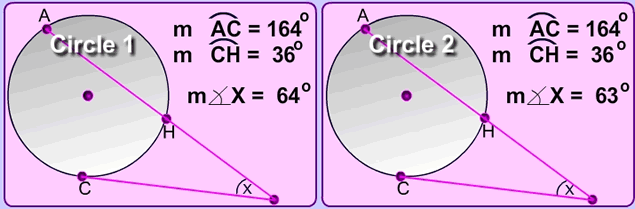
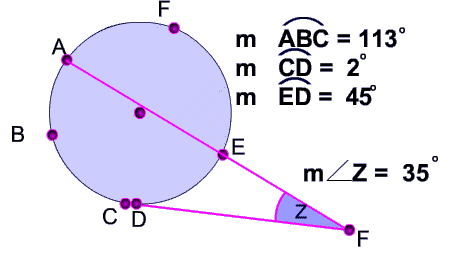
Problem 7
Use your knowledge of the theorems on this page to determine at whether point C or point D is where the bottom segment
intersects the circle. In other words, is point D tangent to
the circle?
Since $$ \frac{1}{2}(113- 45) \ne 35. $$ The segment is not tangent to the circle at C.
However, $$\frac{1}{2}(115- 45) = 35 $$ so the segment intersects point D. (the 115 represents 113 + 2 which is the sum of arc ABC + arc CD)