{(0, 1, 2 ) , (3,4,5)} ( these numbers are grouped as 3's so not ordered and therefore not a relation )
{-1, 7, 3,4,5,5}
One more time: A relation is just a set of ordered pairs. There is absolutely nothing special at all about the numbers that are in a relation. In other words, any bunch of numbers is a relation so long as these numbers come in pairs.
Video Lesson
What is the domain and range of a 'relation'?
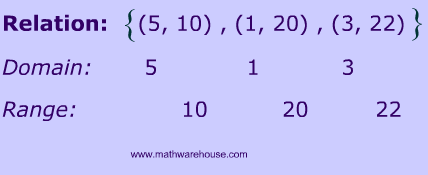
The domain:
Is the set of all the first numbers of the ordered pairs. In other words, the domain is all of the x-values.
The range:
Is the set of the second numbers in each pair, or the y-values.
Example 1
In the relation above the domain is { 5, 1 , 3 } .( highlight )
And the range is {10, 20, 22} ( highlight ).
Example 2
Domain and range of a relation
In the relation above, the domain is {2, 4, 11, -21}
the range is is {-5, 31, -11, 3}.
Example 3
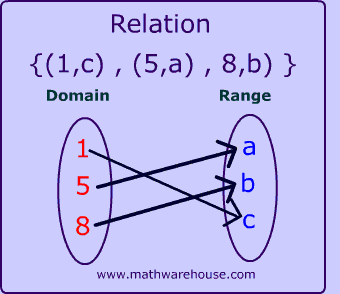
Arrow Chart
Relations are often represented using arrow charts connecting the domain and range elements.
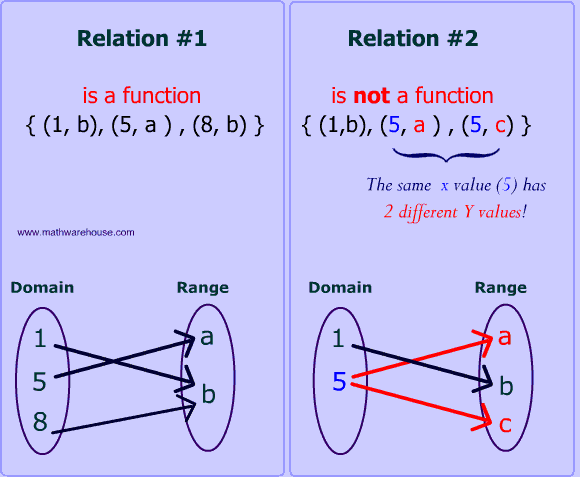
In mathematics, what distinguishes a function from a relation is that each x value in a function has one and only ONE y-value.
Since relation #1 has ONLY ONE y value for each x value, this relation is a function.
On the other hand, relation #2 has TWO distinct y values 'a' and 'c' for the same x value of '5' . Therefore, relation #2 does not satisfy the definition of a mathematical function.
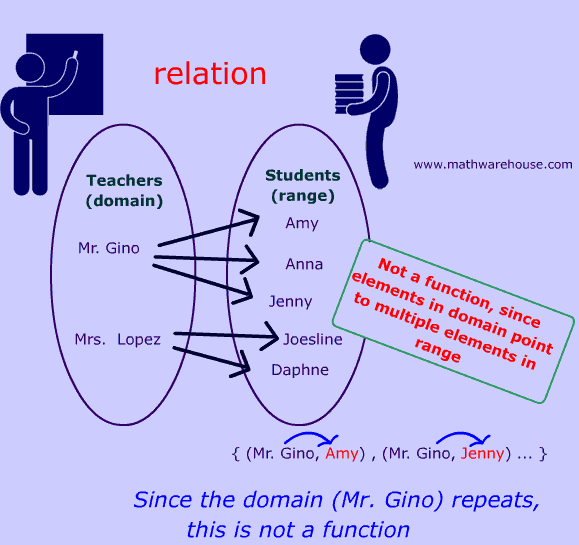
Teachers has multiple students
If we put teachers into the domain and students into the range, we do not have a function because the same teacher, like Mr. Gino below, has more than 1 student in a classroom.
Mothers and Daughters Analogy
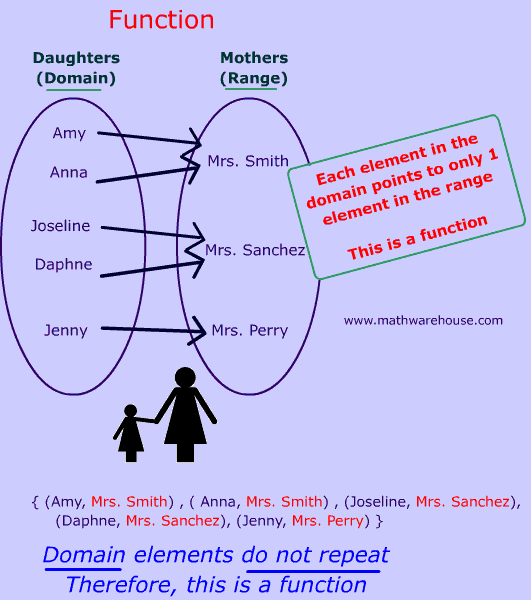
A way to try to understand this concept is to think of how mothers and their daughters could be represented as a function.
Each element in the domain, each daughter
, can only have 1 mother (element in the range).
Some people find it helpful to think of the domain and range as people in romantic relationships. If each number in the domain is a person and each number in the range is a different person, then a function is when all of the people in the domain have 1 and only 1 boyfriend/girlfriend in the range.
Compare the two relations on the below. They differ by just one number, but only one is a function.
What's an easy way to do this?
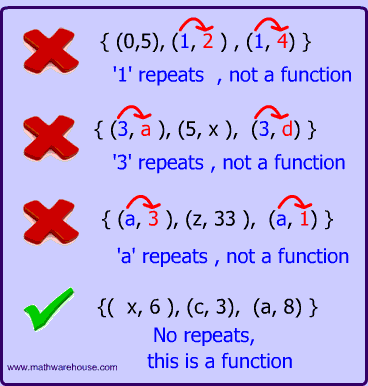
Look for repeated elements in the domain. As soon as an element in the domain repeats, watch out!
Relation #1 and Relation #3 are functions because each x value, each element in the domain, has one and only only one y value, or one and only number in the range.
For the following relation to be a function, X can not be what values?
{(8 , 11), (34,5), (6,17), (X ,22)}
X cannot be 8, 34, or 6.
If x were 8 for instance, the relation would be:
{(8, 11), (34, 5), (6, 17), (8 ,22)}
In this relation, the x-value of 8 has two distinct y values. Therefore this relation would NOT be a function since each element in the domain must have 1 and only value in the range.
Practice 4
For the relation below to be a function, X cannot be what values?
{(12, 13), (-11, 22), (33, 101), (X, 22)}
X cannot be 12 or 33.
If x were 12 for instance, the relation would be: {(12 , 13), (-11, 22), ( 33, 101), (12 ,22}
Did we trick you?
In this problem, x could be -11. Since (-11, 22) is already a pair in our relation, -11 can again go with a range element of 22 without creating a problem (We would just have two copies of 1 ordered pair).
If x were -11 , the relation would still be a function: {(12, 13), (-11, 22), (33, 101), (-11, 22)}
The all important rule for a function in math -- that each value in the domain has only 1 value in the range -- would still be true if we had a second copy of 1 ordered pair.
Practice 5
For the relation below to be a function, X cannot be what values?