What is the Inverse of a function?
A conceptual analogyIf the function itself is considered a "DO" action, then the inverse is the "UNDO".
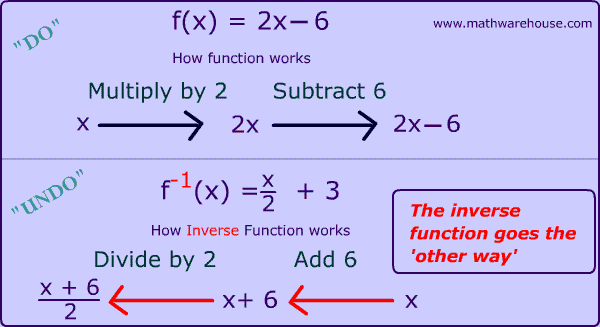

If the function itself is considered a "DO" action, then the inverse is the "UNDO".
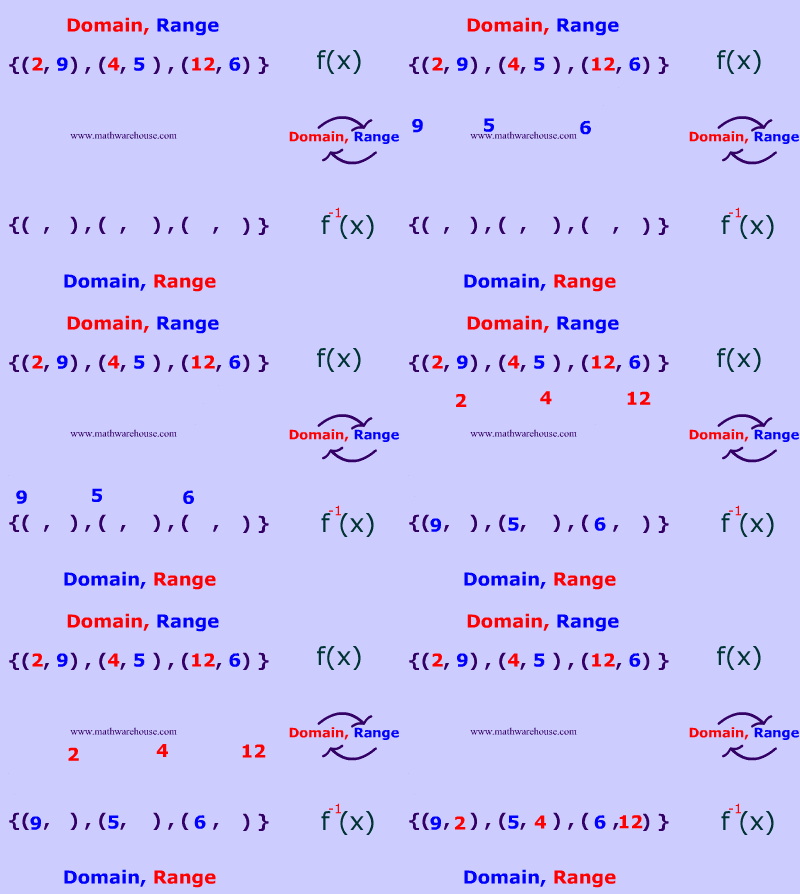
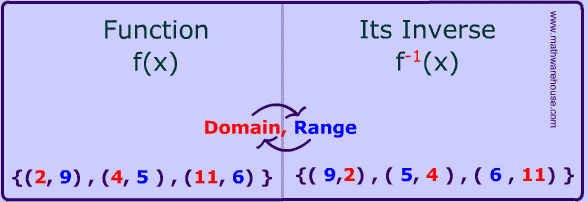
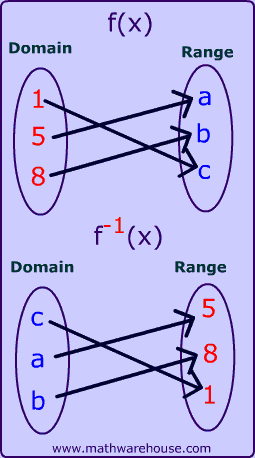
Definition: The inverse of a function is when the domain and the range trade places. All elements of the domain become the range, and all elements of the range become the domain.
Inverse of a Function DemonstrationTherefore, the inverse of a function is equivalent to what kind of transformation?
Reflection over the line y = x.
| Original function f(x) | Inverse of function or f-1(x) |
|---|---|
{(0, 3) , (1, 4) , (2, 5)} |
{(3, 0) , (4, 1) , (5, 2)} |
To answer that question let's look at the function in Diagram 1. In that graph, you can see
the original function and its inverse .
Is the inverse of that function , also a function?
As you can see, the inverse of that function does not pass the vertical line test and, therefore , is not a function.
Conclusion: The inverse of a function is not necessarily a function.
f-1(x), the inverse, is itself a function only when f(x), the original function, is a one-to-one function.
Remember: 1 to 1 functions must pass the horizontal line test!
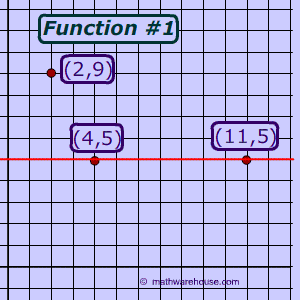
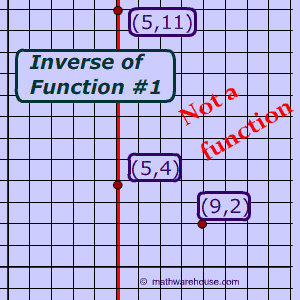
Example 1In this case, f(x) is a function, but f-1(x) is nota function.
Function #1, f(x) is not a one to one function because it does not pass the horizontal line test .
. f-1(x) is not a function.
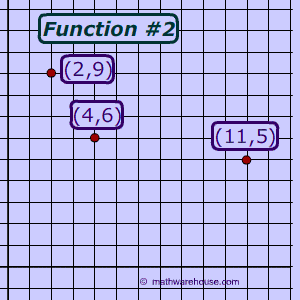
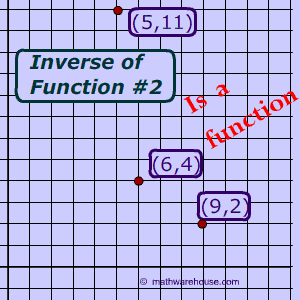
In this case, f(x) is a function and f-1(x) is also a function.
This function passes the horizontal line test so, its inverse will also be a function.
Remember: $$ f^{-1} (x) $$ means 'the inverse of f(x) '.
$$ f^{-1} (x) $$ = {(2, 1) , (4, 3) , (6, 5)}
Remember: $$ f^{-1} (x) $$ means 'the inverse of f(x) '.
$$ f^{-1} (x) $$ = {(14, 33) , (15, 23) , (12, 11) , (14, 13)}}
Remember: $$ f^{-1} (x) $$ means 'the inverse of f(x) '.
$$ f^{-1} (x) $$ = {(12, -1) , (114, 13) , (61, 15) , (12, 1)}
y = 3 is a horizontal line. In a horizontal line all elements of the range are 3.
So, it looks something $$ f^{-1} (x) $$ ={(-1,3) , (0, 3) , (1, 3)}.
Therefore the inverse of this function will be whatever line has 3 for all elements in its domain.
Therefore the inverse of y = 3 is the line x = 3.
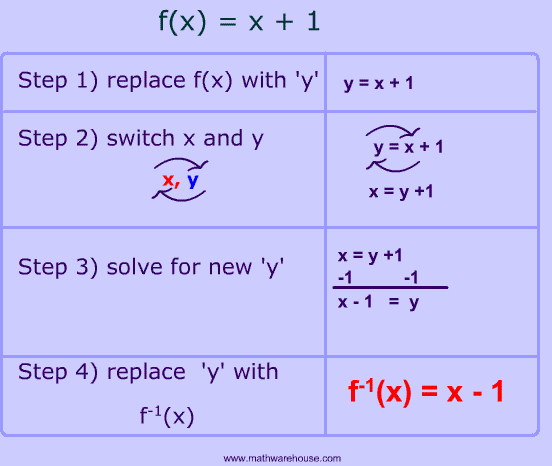
Just like in our prior examples, we need to switch the domain and range. I n an equation, the domain is represented by the x variable and the range by the y variable.
f(x): took an element from the domain and added 1 to arrive at the corresponding element in the range.
f-1(x) : took an element from the domain and subtracted 1 to arrive at the corresponding element in the range.
Replace f(x) with y.
$$ y = x + 22 $$
Switch x and y.
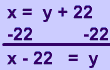
$$ x = y + 22 $$
Solve for new 'y'.
Replace 'y' with f-1(x).
$$ f^{-1} (x) = x - 22 $$
Replace f(x) with y.
$$ y = 2x $$
Switch x and y.
$$ x = 2y $$
Solve for new 'y'.
$$ \frac{1}{2} x = \frac{1}{2} \cdot 2y \\ \frac{1}{2} x = y $$
Replace 'y' with f-1(x).
$$ f^{-1} (x) =\frac{1}{2} x $$
Replace f(x) with y.
$$ y = \frac{1}{2}x + 3 $$
Switch x and y.
$$ x = \frac{1}{2}y + 3 $$
Solve for new 'y'.
$$ \color{Red}{2 \cdot} x = \color{Red}{2 \cdot} \big (\frac{1}{2}y + 3 \big) \\ 2 \cdot x = \frac{2}{2}\cdot y + 2 \cdot 3 \\ 2x = y + 6 \\ 2x -6 = y $$
Replace 'y' with f-1(x).
$$ f^{-1} (x) = 2x -6 $$
Replace f(x) with y.
$$ y = x^2 + 3 $$
Switch x and y.
$$ x = y^2 + 3 $$
Solve for new 'y'.
$$ x \color{Red}{-3} = y^2 + 3 \color{Red}{-3} \\ x -3 = y^2 \\ \sqrt{x-3} = \sqrt{y^2} \\ \sqrt{x-3} = y $$
Replace 'y' with f-1(x).
$$ f^{-1} (x) = \sqrt{x-3} $$
Replace f(x) with y.
$$ y = 5 \sqrt{x} $$
Switch x and y.
$$ x = 5 \sqrt{y} $$
Solve for new 'y'.
$$ x{\color{Red}{^2}} = \big(5 \sqrt{y} \big) {\color{Red}{^2}} \\ x^2 = 5{\color{Red}{^2}} \cdot (\sqrt{y}){\color{Red}{^2}} \\ x^2 = 25y \\ \frac{1}{25} \cdot x^2 = \frac{1}{25} \cdot 25y \\ \frac{1}{25} \cdot x^2 = y $$
Replace 'y' with f-1(x).
$$ f^{-1} (x) = \frac{1}{25} \cdot x^2 $$
 Another Example

 To Summarize