This page : Lesson | Practice | Complex Conjugates
Just like multiplying binomials
To multiply two complex numbers such as $$\ (4+5i )\cdot (3+2i) $$ , you can treat each one as
a binomial
and apply the foil method to find the product.
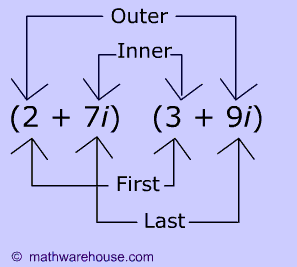
FOIL stands for
first ,
outer ,
inner , and
last
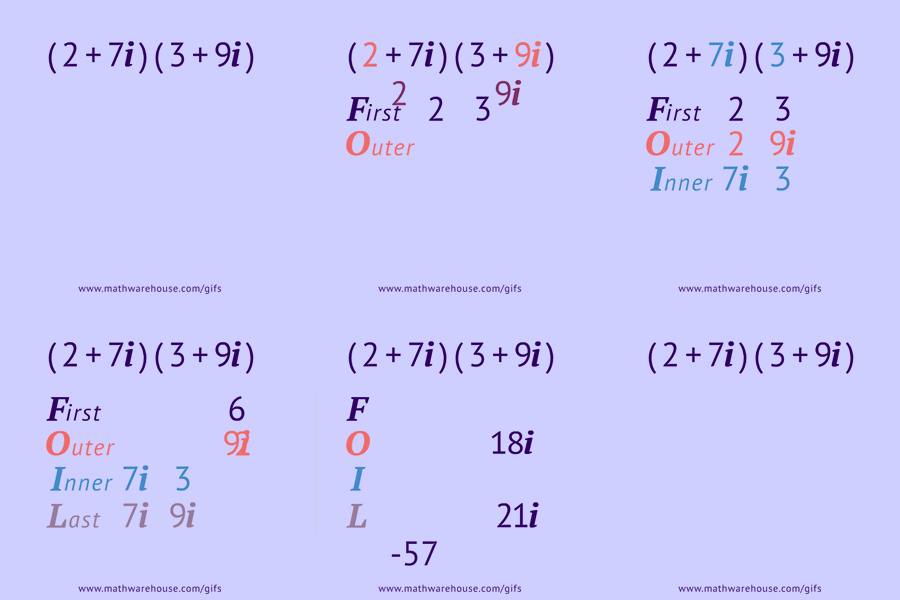
pairs. You are supposed to multiply these pairs as shown below!
Firsts:
$$ 2 \cdot 3= 6 $$
Outers:
$$ 2 \cdot 9i =18i $$
Inners:
$$ 7i \cdot 3 =21i $$
Lasts:
$$ 7i \cdot 9i =$$ $$63i^2$$ $$ = 63\cdot -1 = -63 $$
Note: the $$ i^2 $$ simplifies to $$ -1 $$ .
So, now that we've multiplied, what is next?
Add up each term!
$$ 6 $$
$$ 18i $$
$$ 21i $$
$$ -63$$
$$ \bf{39i - 63} $$
Content on this page requires a newer version of Adobe Flash Player.
Video Tutorial on Multiplying Complex Numbers
VIDEO
Example 1
Let's multiply the following 2 complex numbers $$ \bf{ (5 + 2i) (7 + 12i)} $$
Step 1
Foil the binomials.
$$
\begin{array}{| c|c | c | }
\bf{F} & ( \red 5 + 2i)( \red 7 +12i ) & 5 \cdot 7 & 35
\\\hline
\bf{O} & ( \red 5 + 2i)( 7 +\red{12i } ) & 5 \cdot 12i & 60i
\\\hline
\bf{I} & ( 5 + \red{ 2i})( \red 7 + 12i ) & 2i \cdot 7 & 14i
\\\hline
\bf{L} & ( 5 + \red{ 2i})( 7 +\red{12i } ) & 5i \cdot 12i & 24i^2 = -24
\\\hline
\end{array}
$$
Remember $$ i^2 = -1 $$ , so $$ 24i^2 = 24 \cdot -1 = -24 $$
Step 2
Simplify by adding the terms
$$ 35 $$
$$ 60i $$
$$ 14i $$
$$ + (-24) $$
$$ \bf{ 11+ 74i} $$
This page : Lesson | Practice | Complex Conjugates
Practice Problems I
Problem 1.1
Step 1
Step 1 answer
$$
\begin{array}{| c|c | c | }
\bf{F} & ( \red 5 + 4i)( \red 6 + 4i ) & 5 \cdot 6 & 30
\\\hline
\bf{O} & ( \red 5 + 4i)( 6 +\red{4i } ) & 5 \cdot 4i & 20i
\\\hline
\bf{I} & ( 5 + \red{ 4i})( \red 6 + 4i ) & 4i \cdot 6 & 24i
\\\hline
\bf{L} & ( 5 + \red{ 4i})( 6 +\red{4i } ) & 4i \cdot 4i & -16_{\blue{ [1]}}
\\\hline
\end{array}
$$
$$ [\blue 1] $$ Remember $$ i^2 = -1 $$ , so
$$ 4i \cdot 4i = 16i^2 = 16 \cdot -1 = -16 $$
Step 2
Simplify by adding the terms
Step 2 answer
$$30$$
$$20i$$
$$24i$$
$$+ (-16)$$
$$\bf{14+ 44i}$$
Problem 1.2
Step 1
Step 1 answer
$$
\begin{array}{| c|c | c | }
\bf{F} & ( \red 9 + 7i)( \red 6 + 8i ) & 9 \cdot 6 & 54
\\\hline
\bf{O} & ( \red 9 + 7i)( 6 +\red{8i } ) & 9 \cdot 8i & 72i
\\\hline
\bf{I} & ( 9 + \red{ 7i})( \red 6 + 8i ) & 7i \cdot 6 & 42i
\\\hline
\bf{L} & ( 9 + \red{ 7i})( 6 +\red{ 8i } ) & 7i \cdot 8i & 56i^2 = -56
\\\hline
\end{array}
$$
Remember $$ i^2 = -1 $$ , so
$$ 56i^2 = 56 \cdot -1 = -56 $$
Step 2
Simplify by adding the terms
Step 2 answer
$$54$$
$$72i$$
$$42i$$
$$+ (-56)$$
$$\bf{-2 + 114i}$$
Problem 1.3
Step 1
Step 1 answer
$$
\begin{array}{| c|c | c | }
\bf{F} & ( \red 2 - 4i)( \red 3 + 5i ) & 2 \cdot 3 & 6
\\\hline
\bf{O} & ( \red 2 - 4i)( 3 +\red{5i } ) & 2 \cdot 5i & 10i
\\\hline
\bf{I} & ( 2 - \red{ 4i})( \red 3 + 5i ) & -4i \cdot 3 & -12i
\\\hline
\bf{L} & ( 2 - \red{ 4i})( 3 +\red{ 5i } ) & -4i \cdot 5i & -20i^2 = 20
\\\hline
\end{array}
$$
Remember $$ i^2 = -1 $$ , so
$$ -20i^2 = -20 \cdot -1 = 20 $$
Step 2
Simplify by adding the terms
Step 2 answer
$$6$$
$$10i$$
$$12i$$
$$+ (20)$$
$$]bf{26 - 2i}$$
This page : Lesson | Practice | Complex Conjugates
Complex Conjugate
Complex conjugates are any pair of complex number
binomials that look like the following pattern:
$$ (a \red+ bi)(a \red - bi) $$
Here are some specific examples. Note that the only difference between the two binomials is the
sign .
$
\text{Complex Conjugate Examples}
$
$
\\(3 \red + 2i)(3 \red - 2i)
\\(5 \red + 12i)(5 \red - 12i)
\\(7 \red + 33i)(5 \red - 33i)
\\(99 \red + i)(99 \red - i)
$
Multiplying complex conjugates causes the middle term ( the $$i$$ term) to cancel as
example 2 below illustrates.
Example 2 (Complex Conjugate)
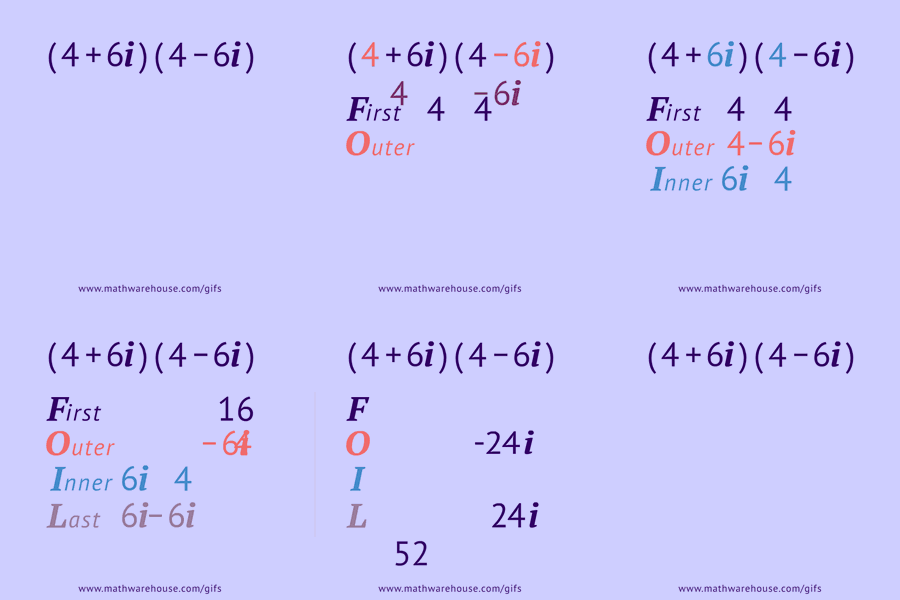
Let's multiply 2 complex conjugates $$ (4 + 6i)(4 - 6i) $$
Step 1
Foil the binomials.
$$
\begin{array}{| c|c | c | }
\bf{F} & ( \red 4 + 6i)( \red 4 - 6i ) & 4 \cdot 4 & 16
\\\hline
\bf{O} & ( \red 4 + 6i)( 4 -\red{6i } ) & 4 \cdot -6i & -24i
\\\hline
\bf{I} & ( 4 + \red{ 6i})( \red 4 - 6i ) & 6i \cdot 4 & 24i
\\\hline
\bf{L} & ( 4 + \red{ 6i})( 4 - \red{6i } ) & 6i \cdot -6i & 36_{\blue{ [1]}}
\\\hline
\end{array}
$$
$$[\blue{1}]$$ Remember $$ i^2 = -1 $$ , so $$ -36i^2 = -36 \cdot -1 = 36 $$
Step 2
Simplify by adding the terms
$$ 16 $$
$$ \red{-24i} $$
$$ \red{24i} $$
$$ + 36 $$
$$ \bf{52} $$
(notice how the imaginary terms are
additive inverses
or 'cancel' each other)
Shortcut for Multiplying Complex Conjugates
There is a shortcut that you can use to quickly multiply complex conjugates.
As you can see from the last example.
$
(4+6i)(4-6i) = 16 + 36
\\
(\red 4+ \blue 6i)(\red 4- \blue 6i) = \red{4^2} + \red{6^2}
$
Shortcut:
$ (\red a + \blue b i)( \red a - \blue b i)= \boxed{ \red {a^2} + \blue {b^2} } $
Problem 2.1
Step 1
Step 1 answer
$$
\begin{array}{| c|c | c | }
\bf{F} & ( \red 5 + 4i)( \red 5 - 4i ) & 5 \cdot 5 & 25
\\\hline
\bf{O} & ( \red 5 + 4i)( 5 -\red{4i } ) & 5 \cdot \red- 4i & \red-20i
\\\hline
\bf{I} & ( 5 + \red{ 4i})( \red 5 - 4i ) & 4i \cdot 5 & 20i
\\\hline
\bf{L} & ( 5 + \red{ 4i})( 5 - \red{ 4i } ) & 4i \cdot \red-4i & -16i^2 = 16
\\\hline
\end{array}
$$
Remember $$ i^2 = -1 $$ , so
$$ -16i^2 = -16 \cdot -1 = 16 $$
Step 2
Simplify by adding the terms
Step 2 answer
$$25$$
$$\red{-20i}$$
$$\red{20i}$$
$$+ 16$$
$$\bf{41}$$
Shortcut: There is a shortcut that applies to complex conjugates of the form
$$ (\red a + \blue b i)( \red a - \blue b i)$$
like this question. The solution is always $$ \red {a^2} + \blue {b^2} $$ .
In this case: $$ \red {5^2} + \blue {4^2} $$ = 41
Problem 2.2
Step 1
Step 1 answer
$$
\begin{array}{| c|c | c | }
\bf{F} & ( \red 6 + 2i)( \red 6 - 2i ) & 6 \cdot 6 & 36
\\\hline
\bf{O} & ( \red 6 + 2i)( 6 -\red{2i } ) & 6 \cdot \red- 2i & \red-12i
\\\hline
\bf{I} & ( 6 + \red{ 2i})( \red 6 - 2i ) & 2i \cdot 6 & 12i
\\\hline
\bf{L} & ( 6 + \red{ 2i})( 6 - \red{ 2i } ) & 2i \cdot \red-2i & -4i^2 = 4
\\\hline
\end{array}
$$
Remember $$ i^2 = -1 $$ , so
$$ -4i^2 = -4 \cdot -1 = 4 $$
Step 2
Simplify by adding the terms
Step 2 answer
$$36$$
$$\red{-12i}$$
$$\red{12i}$$
$$+ 4$$
$$\bf{40}$$
Shortcut: There is a shortcut that applies to complex conjugates of the form
$$ (\red a + \blue b i)( \red a - \blue b i)$$
like this question. The solution is always $$ \red {a^2} + \blue {b^2} $$ .
In this case: $$ \red {6^2} + \blue {2^2} $$ = 40
Problem 2.3
Step 1
Answer
Use the shortcut to rewrite the left side.
$
(\red 1 + \blue ai ) (\red 1 - \blue ai) = 2
\\
\red {1^2} + \blue {a^2} = 2
\\
1 + a^2 = 2
\\
a^2 = 1
\\
a= \sqrt 1
\\
a= 1
$