|
|
|
|
|
|
![]() ![]() |
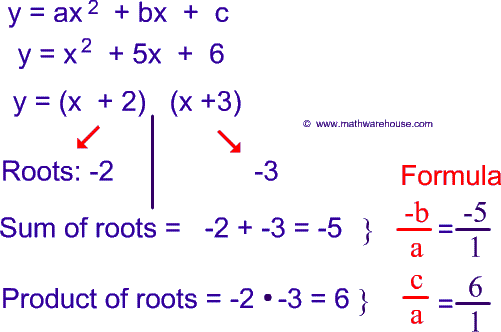
Formula: Sum & Product of RootsRelationship between equation and rootsRelated: Solving Quadratic Equations| Solve Quadratic Equations By Factoring | The Quadratic Formula | Discriminant |completing the square in math|Completing Square Calculator| Quadratic Formula Calculator | formula for sum and product of roots | Quadratic Inequalities |images The formulassum of roots: −b/aproduct of roots: c/a As you can see from the derivation below, when you are trying to solve aquadratic equations in the form of ax2+bx +c. The sum and product of the roots can be rewritten using the two formulas above.
Example 1
The example below illustrates how this formula applies to the quadratic equation x2 + 5x +6. As you can see the sum of the roots is indeed -b/a and the product of the roots is c/a. ![]()
Example 2
Practice Problems
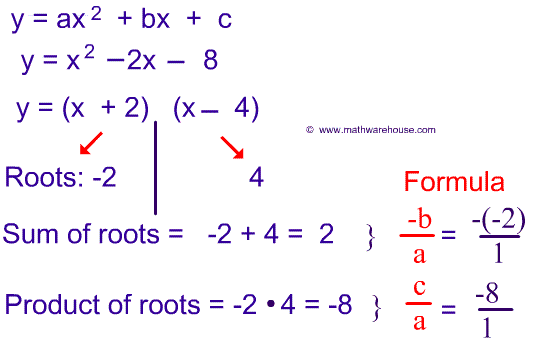
The example below illustrates how this formula applies to the quadratic equation x2 - 2x - 8. Again, both formulas--for the sum and the product boil down to -b/a and c/a, respectively. ![]() Problem 1) Without solving, find the sum and product of the roots equation: 2x2 -3x -2 = 0
a = 2 b = -3 c = -2 now, subsitute these values into the formulas
Problem 2) Without solving, find the sum & product of the roots of the following equation: -9x2 -8x = 15
0 = ax2 + bx + crewritten equation: -9x2 -8x - 15 = 0 Identify the coefficients: a = -9 b = -8 c = -15 now, subsitute these values into the formulas
Problem 3) Write the quadratic equation given the following roots: 4 and 2
However, since this page focuses using our formulas, let's use them to answer this equation. Sum of the roots = 4 + 2 = 6 Product of the roots = 4 * 2 = 8 We can use our formulas, to set up the following two equations
a = 1 b = -6 c = 8 So our final quadratic equation is y = 1x2 -6x + 8 You can double check your work by foiling the binomials (x -4)(x-2) to get the same equation Problem 4)If one root of the equation below is 3, what is the other root? x2 -5x + 6 = 0
Write down what you know: a = 1 b = -5 r1 = 3 now, subsitute these values into the sum of the roots ormula
Therefore the missing root is 2. We can check our work by foiling the binomials |