
|
 

|
Composition of Reflections TheoremsParallel Lines, Intersecting Lines, Translations
Theorems involving reflections in mathematics
Note: Usually mathematicians have a keen sense of orderliness and consistency. However, there is an exception to this habit of consistency when it comes to the
conventions/notation for compositions of transformations. There are two separate ways of interpreting the following symbols:
rx-axis•ry-axisThe one convention is to read the composition from right to left ie. First perform ry-axis and then perform rx-axisHowever, an equally prevelant notation is to read from left to right! ie. First perform rx-axis and then perform ry-axis So what are you to do? If you are reading a math book or learning from a teacher,either source has, hopefully, already indicated which notation you are following. If you happen to be in the state of New York, the Math B Regents exam follows the right to left notation, a notation that is consistent with that of composition of functions. In order to accomodate both notations for compositions of reflections, many of the exercises on this page have radio buttons that allow you to chose 'left to right' or 'right to left'. However, the bottom exercises all use the 'right to left' notation that New York State and others use. Reflect the quadrilateral below across the parallel lines x=2 and x=5, then determine what translation expresses this composition of reflections. Use the parallel lines theorem. In the interactive exercise below, Try to determine what translation expresses the composition of reflections across the parallel lines y= x + 1 and y=x-3.
Challenge Problem
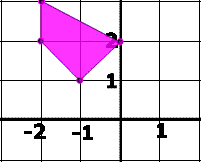 The shape on the left is going to be reflected across the line y =1, then the image will be reflected across y = 2, then the new image will be reflected across the line y = 3, and so on and so forth across y= 4, y = 5, y = 6, y = 7 �..y = 101. After all of the reflections have occurred is the transformation from the pre-image(shown on the left) to the final image a translation? Why or why not?
Intersecting Lines Theorem
Given the triangle below, perform a composition of reflections over the x-axis then the y-axis, then determine how to express that composition of reflections as a mathematical rotation. (Right to Left) The composition of reflections over the x-axis then the line y=x is equivalent to what rotation about the origin.
Show Rotation 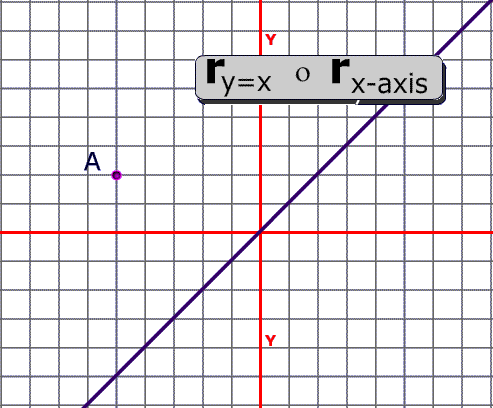
The composition of reflections over the y-axis then x-axis is equivalent to what rotation about the origin.
Perform Composition of reflections 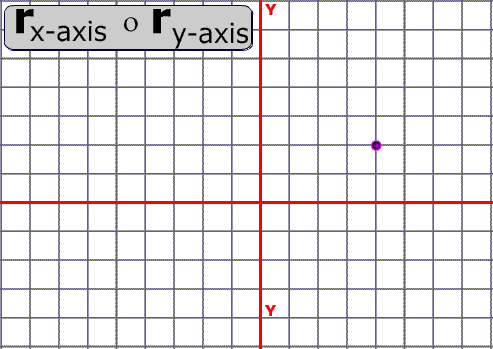
What rotation expresses the composition of reflections.
Show Rotation 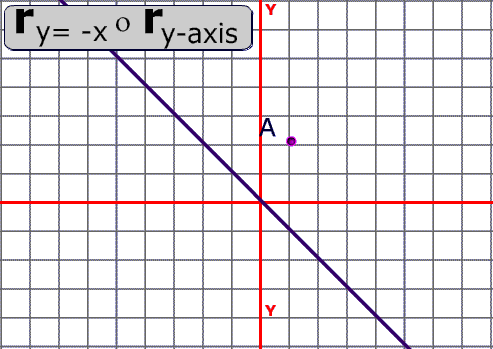
Perform the compostion of reflection then determine what rotation expresses the composition.
Show Rotation 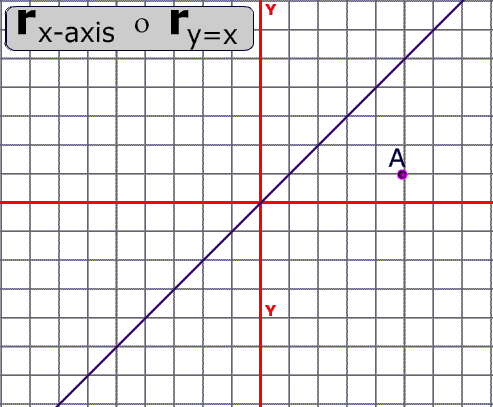
Restate the composition as a rotation.
Answer 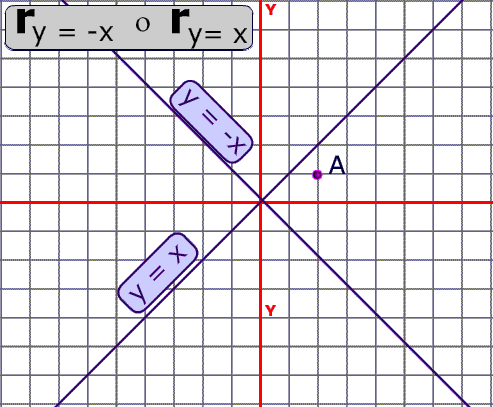
Challenging problem. Imagine that a computer program is going to take the point (3,1) and perform the composition of reflections of
rx-axis• ry-axis
a total of 100 times! What are the coordinates of the final image?
What would the coordinates of the image be if the program only performed 99 compositions of the reflection? (Helpful hint: You will arrive at the same answer to this problem if you read the compostion right to left or left to right)
|
 Graphing Calc
